Veganism as Home:
Be Careful With Each Other, So That We Can Be Dangerous Together

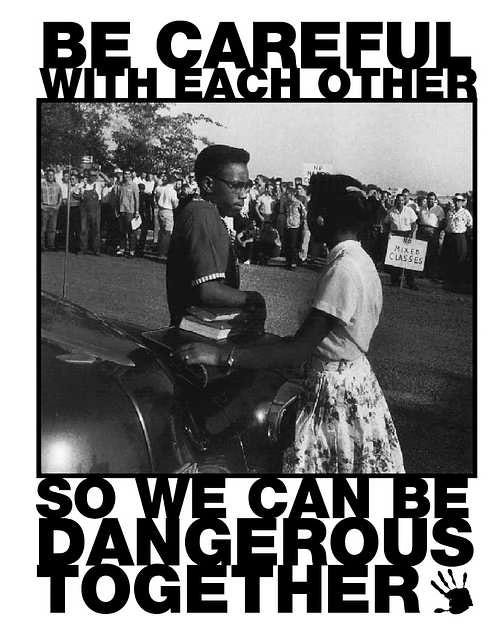
I have been vegan for over 25 years. In that quarter of a century, a person who has eaten meat has never complimented me for being vegan. Of course not. Why would they? They have never thanked me for what I am doing for animals. They have never told me that they appreciate me for being vegan. Of course not; it feels silly to even write these sentences. They have made fun of me. They have made me feel “extra,” like an imposition, not fed me and made it seem like I was being difficult.
My son has only been vegan for three years—after all, he is only three years old. But already he has sat in day care where every other child received ice cream and he received nothing, because they forgot to ask us to bring a vegan option. Already he is asking us why he is the only child in his entire day care who is vegan. Just this morning he asked why his closest friend, Lee, eats meat. “Why,” he asked over his bowl of oatmeal, “isn’t Lee vegan?”
All we have is each other.
As bell hooks wrote: “Without community there is no liberation.”
There are far more vegans and vegetarians than we are led to believe. Of course there are—why would people who eat meat want to admit that there is a large number of people who do not? Vegetarian and vegan combined, our best numbers are 9 percent (plus or minus 3). Even vegan, it’s probably 4-5% (plus or minus 3)1. We are not alone—not by a long shot. But even still, even at 4% vegan, that’s still 96% of the public who are consuming animal products. Another vegan—even if they do not agree with us on everything, even if they are using, in our opinion, the wrong strategy for animal liberation, even if they do something we find annoying—is still something different, better, than 96% of the entire rest of the population. That is special and worthy of appreciation by us. And that matters, because all we have is each other.
Another article landed recently about why people do not stay vegan. The author interviewed 50 people who did not stay vegan. The number one reason? You already know the answer, because every—every—every study just keeps finding the same answer: because they felt alone and isolated. 23 of the 50 people who stopped being vegan cited social isolation as the reason they stopped being vegan. Here is part of the article:
One woman told me she stopped getting invited to her book club because she’d politely declined their potlucks too many times. Another guy said his college friends just stopped texting him about hangouts. Here’s what hit me: these weren’t people being difficult about their veganism. They were just existing as vegans in spaces that weren’t built for them. The isolation wasn’t about the food. It was about being seen as the person who makes everything complicated, even when you’re trying your hardest not to.
This is similar data highlighted by the multiple studies on the effects of vegan stigma. It is the same trend found in two different studies by Faunalytics. Every piece of evidence I can find on vegan retention keeps coming back with the same conclusion: People do not stop being vegan because they start to miss the taste of meat. They do not stop being vegan because they really miss bacon. They do not even stop being vegan because they stop believing in or supporting vegan ethics. They, overwhelmingly, stop being vegan for one reason: they feel isolated and alone.2
The third most common reason? Because they feel overly judged and not supported by other vegans. For them, being around other vegans did not feel like being “home.” They did not feel like they were surrounded by their chosen family, who gets them, and loves them. Here is how the article talked about that one:
This one hurt to hear, but twelve people specifically mentioned toxic experiences with other vegans. Someone posted a picture of their meal in a vegan Facebook group and got attacked because one ingredient might not have been organic. Another person asked a genuine question about B12 and got called a fake vegan. The purity politics are real, and they’re doing serious damage. When you’re already struggling and the people who are supposed to be your community are critiquing your every move, why would you stay? One ex-vegan told me she felt more judgment from vegans than she ever did from meat-eaters.
My spouse and I have a rule in our marriage: we always pull our punches when we fight. After seventeen years of marriage, we know exactly how to hurt each other if we wanted to. But we do not. Early on, we talked about love as an umbilical cord of connection. If you protect it, it grows stronger, like rings in a tree, and can last through any struggle. However, if it breaks, nothing can repair it. Somehow it is both impossibly resilient and impossibly fragile at the exact same time, it protects us and, at the same time, it has to be protected.
In my experience, the same is true for children. With them, they have a literal umbilical cord, and that becomes a cord of trust. As long as you do not break it, it only grows stronger. In our family, we have three rules: families share; families help each other; families love each other.
The same should be true for our chosen families. We should pull our punches, even when we disagree. This does not mean avoiding disagreement—my spouse and I diagree all the time, my son and I disagree, my brother and I disgree (him most of all)—it means not breaking the bonds of trust, not making another vegan feel so alone or isolated that they feel more alone with other vegans than with people who pay to hurt animals. It means making veganism a home. It’s about remembering that even when someone has lost their way, they can always change, they can always come back, we can always call them back in, not out.
To be clear: I mean we pull our punches with each other. We should never pull our punches with corporations, with animal agriculture, with the systems that profit from animal suffering. Indeed, quite the opposite: Against them, we should hit as hard as we possibly can. But with each other—with our comrades, our chosen family—we protect the cord. We are careful with each other, so that we can be more dangerous together. In a world in which we are all that we have, we need every vegan.
Imagine instead of my son being alone, there had been just one other vegan with him that day. Imagine if even one of his teachers had been vegan. The difference between just one and two is larger than math.
With one more, he is not alone, there is a friendship. At three more, there is a group. At four more, it is a community. At five more—well I very much doubt they keep forgetting the vegan option. That is the point.
The major problem stopping more people from being vegan is that they feel alone. That means that every vegan helps create the conditions for more people to go vegan. And those vegans, in turn, help other people to stay vegan. Think of a snowball rolling down a hill, getting bigger and faster. That is actually how social change works: Change is not linear—we see that nowhere in the study of social revolution. It is exponential. As more people feel that there are more vegans—as veganism becomes more visible and more normal—more people go vegan, who then help other people stay vegan and, in turn, help create more vegans. The number shifts—all at once. That is what we see virtually every time in every social movement. That is why social change, when it happens, always feels so…obvious.
But to get there—to get the ball rolling, to keep it rolling—we have to increase retention. We have to help people stay vegan. Remember, as many as 84 percent of vegetarians and vegans stop being vegan—because they feel alone, isolated, and overly judged.3 If we decreased how many new vegans we were recruiting—if we recruited only 20 percent as many, or even half as many—but all of them stayed, we would have actually increased the total number of vegans in the world. We do not need new recruitment strategies. We—you—are doing great on recruitment. We need better retention strategies. We need to help people stay vegan.
Retention is not abstract; it is something we practice every day with each other.
How can we help vegans to stay vegan? Overwhelmingly, what ex-vegans tell us (as well as closet vegans, as well as people explaining why they don’t go vegan) is: social stigma. Feeling isolated. Feeling alone. Feeling without friends. Feeling unappreciated and judged. Feeling like they aren’t making a difference, like they can’t win, so why even try? This view, right here—this is why we are not winning yet. But this view, right here, we as vegans can fix.
In the whole world, only another vegan will thank a vegan for being vegan. That’s you. You’re a vegan. Which means today—today—you can thank another vegan for what they are doing. Because today is the day a vegan is about to quit, I promise. I don’t know who, I don’t know where, but I know for a mathematical certainty that today—today—someone who is vegan is about to stop because they don’t know, yet, that veganism is home, where they are home, where they are loved, where they belong.
In your vegan group, do things that have nothing at all to do with animals. Host a vegan board game night. Go to a movie together. Go on a hike. That, right there, is highly effective vegan advocacy. Think about it this way: if not being part of a book club with people who eat meat is what causes someone to stop being vegan, can’t having a vegan book club help keep someone vegan who otherwise might have quit? Some people will even come—and stay—vegan for that feeling of community itself.
I am part of a monthly vegan reading group. We read books about veganism and have a vegan dinner afterward. Incredibly, non-vegans come all the time—we keep inviting them. We do not proselytize; after all, the first half is reading an explicit book on veganism—an argument for veganism—and then we all eat delicious vegan food together and spend time talking. Sometimes they explain why they “can’t” go vegan, we don’t get mad at them or yell at them, we simply say, “We are glad you are here; keep coming back.”
The same forces that hurt our movement can become our strongest forces. For example, if you are part of an organization, assign mentors—older vegans (measured by years vegan) to newer vegans—and make it official. It helps keep both the mentee and the mentor vegan. However we do it, we have to replace the community people “lose” by being vegan. We have to build a parallel world to the one we are fighting against: an inclusive, supportive vegan community. We have to make veganism a home—where people feel seen, appreciated, and loved.
If today is the day you were feeling alone, or isolated: Thank you. Thank you. Thank you. We are in this together. You are part of my family. Right now—right this second—right as you’re reading this—even if we don’t know each other and even if we have never met, thank you. All I have is you; because all a vegan has in this struggle is, and always has been, each other. A family is a team, and a team, a real team, can also become a family. We cannot do it alone. We can only do it together.
Slaughterhouse capitalism teaches us that we are alone. But we are not alone. My son was not alone, even if in that second he felt like it because we, his whole family, were with him, because in truth you were with him, in your heart, even though you have never met him. Did we buy him ice cream afterwards? Of course we did. Would you have bought him vegan ice cream? Of course you would have because you, and I, and him are, and always will be, on the same team. We are not alone. Yes, all we have is each other but, together, in solidarity, that is and has always been enough. Each of us, right now, today, can create the world we are fighting for; in fact, we have to. We don’t need anyone else’s permission, no one can stop us, each of us, if we want, right now, can make veganism a home. Pulling our punches, calling in instead of calling out, thanking each other, helping each other, loving each other, having each other’s backs, being careful with each other so that we can be dangerous together—making veganism a home where all of us can feel seen, appreciated, and loved. That is how we win. That is what winning feels like.
And, we are going to win.
At very small base rates—for example, around 4 percent—sampling uncertainty makes precise estimation difficult. Many national surveys report margins of error of approximately plus or minus 3 percentage points, which means that a point estimate of 4 percent can plausibly yield reported results ranging from roughly 1 to 7 percent, depending on sampling variation, weighting, and question wording. This is one reason I tend to focus more on the aggregate figure for vegetarians and vegans combined: because the base rate is larger, those estimates are generally more stable and inspire greater confidence. Accordingly, I am fairly confident in the estimate of roughly 9 percent (plus or minus 3 percent) for vegetarians and vegans combined, and somewhat less confident in the estimate of approximately 4 percent (plus or minus 3 percent) for vegans alone, though it remains my best current estimate.
The two Faunalytics studies do not, directly, cite social isolation (although they both cite it as a major factor). This is an extrapolation combining the two Faunalytics studies with the larger body of peer-reviewed data on vegan stigma. It is based on my belief that many of the other categories listed (for example, convenience) are, in essence, social normalization simply expressed differently. For example, someone else might describe Tavi not being able to find vegan ice cream as “inconvenient” instead of socially isolating, but the reality would be the same. See the two Substacks (on the Faunalytics study and on social stigma), both linked above, for a more detailed explanation of both points.
I am doubtful that 84% is the correct number (my guess is that it is too high). Hence my statement "up to 84%." However, while probably too high, there is little doubt that retention is a significant problem and feelings of social isolation are part of the major reason for this lack of retention. See the Substack, linked above, for a more detailed exploration of why I am skeptical of the 84% number, even as it is still the best data we currently have to work with.
Thank you. This resonated so deeply. Thank you for being a part of our vegan family, and articulating this. This is how we win, indeed! And win we will.
"Even vegan, it’s probably 4-5%. We are not alone—not by a long shot. But even still, even at 4% vegan, that’s still 96% of the public who are consuming animal products."
This seems false. What evidence do you have that 4% of the public is vegan? Faunalytics puts it at about 1%.