Veganism as Integrity

Integrity is usually thought of as “honesty.” But that is not what it means. It comes from the Latin word integritas, which means “wholeness” — the same root as, say, integer. Integrity means not compartmentalizing your life. It means learning to stay whole: the same person in public and private, in principle and practice.
My veganism comes from the ecofeminist tradition. My strongest mentor is Carol J. Adams; her work first convinced me to go vegan, and she has guided my scholarly career ever since. And, one of the key ideas of ecofeminism, of feminism itself, is the critique of the public and private divide. After all, the world raising and killing 90 billion land animals a year requires massive numbers of people all working together in concert. No one person, no matter how evil, no matter how depraved, could possibly accomplish it; it takes millions and millions of people all working together, year after year. How do they justify this to themselves? Part of the answer is via the public and private divide.
During the day perhaps they run companies that do horrific things, but then at night they are kind to their spouse, or their mother, or their child, or their companion animal, perhaps they even give their companion animal a Christmas gift, as many, many people do, and this way they still believe they are ethical. Their “public” face might be horrible; they might work for ExxonMobil, or run a company that just cut all their maternity and paternity leave, but as long as they, themselves, are nice to their own wife or their child, in their mind they are still ethical.
I have my doubts about whether it works. I suspect there is near-constant “bleed over” from the unethical things people do during the day to the unethical things they do to their families at night. But there is the idea that the division is even possible — that everyone, but in particular men, can publicly be one way: cruel, dispassionate, aggressive, wholly immoral and focused on profit in the marketplace, but they can still come home and be warm, and kind, and nurturing, and moral.
On the flip side, within leftist communities and within the vegan community, I see the exact mirror inverse: people who espouse lovely ideas, who perform publicly their ethics and their morality, but who, over time, we often find out, did not follow those same ideas at home. They, too, believe in the public and private divide, just flipped. For them, the “public” face was kept deeply moral and home was the gap. They divide themselves: the good part, which for them is the public part, and the not-so-good part, which for them is the private part.
In contrast, what the idea of integrity has taught me is that my goal should be not to compartmentalize myself. My goal is to be the same person, all the time, to everyone; my goal is for there to be no difference, no gap, between my "public" self and my "private" self.
It is one of the reasons I write this Substack in the slightly odd way that I do, to highlight living this way in practice. For example: my son Tavi, while we were visiting a public library in Boston, hit a young girl who wouldn’t do what he wanted. I immediately pulled him away; it is the most “in trouble” he has ever gotten. I told him:
You are a vegan, and vegans do not hurt animals, and the girl was an animal. You cannot be a vegan and do that again.
Tavi has never hit someone again.
The question I get the most from other vegans is what happens if later Tavi decides not to be vegan. But the question itself makes no sense. What would that even mean? Children rebel against hypocrisy; they rebel against abuse and mistreatment; they do not rebel against a fully ethical position of not hurting others that everyone in their family has firmly followed for their entire life and, most importantly, has made them feel protected and loved. Why would they?
I asked him the other day:
Me: Do you even know what the word spanking means?
Tavi: No — what does it mean?
Me: Don’t worry about it; you’ll never need to know.
Vegans do not hurt other animals, and every person, including my own son, is an animal.
That is the gift we can have as vegans: to get to live fully with integrity. To have consistent moral values — all of the time. It is the greatest gift. It is, fundamentally, why being vegan is a gift, a blessing, and a joy.
I teach my students Aristotle, and in particular the Nicomachean Ethics. There are a host of problems with Aristotle — I mean, where to start? But there is one part I deeply and fundamentally agree with, and it is this argument: ethics are the way to happiness. The term he uses is eudaimonia; it literally means eu (good) daimon (spirit).1 And Aristotle’s basic argument is this: most people are not happy because they do not actually like themselves. And the reason they do not actually like themselves is because they are not actually all that good. As I tell my students: people can disagree about whether God is watching; there is no elf on the shelf; Santa is not keeping a list of naughty or nice. But you — you are always watching you. You know you. You can trick other people, but I have my doubts about whether you can trick yourself. So you should be the kind of person you can respect, that you can like, that you would admire and want to be. If you want self-love, actual self-love, think of the kind of person you could love, and then be that person. Serious ethics, sustained over time, equals true self-respect; true self-respect becomes self-love; and self-love equals actual happiness.2 That is the gift veganism gives us.
I have lost nothing in my life — that matters — by going and staying vegetarian since I was nine. I have lost nothing in my life — that matters — by going and staying vegan. I have lost nothing in my life — that matters — by dedicating my life to a single moral goal: animal liberation. Indeed, exactly the opposite: every single thing in my life that matters — the love of my spouse, the ethics of my family, the closeness of my friends, purpose, meaning, liking myself — I have received back every single day. Veganism is my joy.
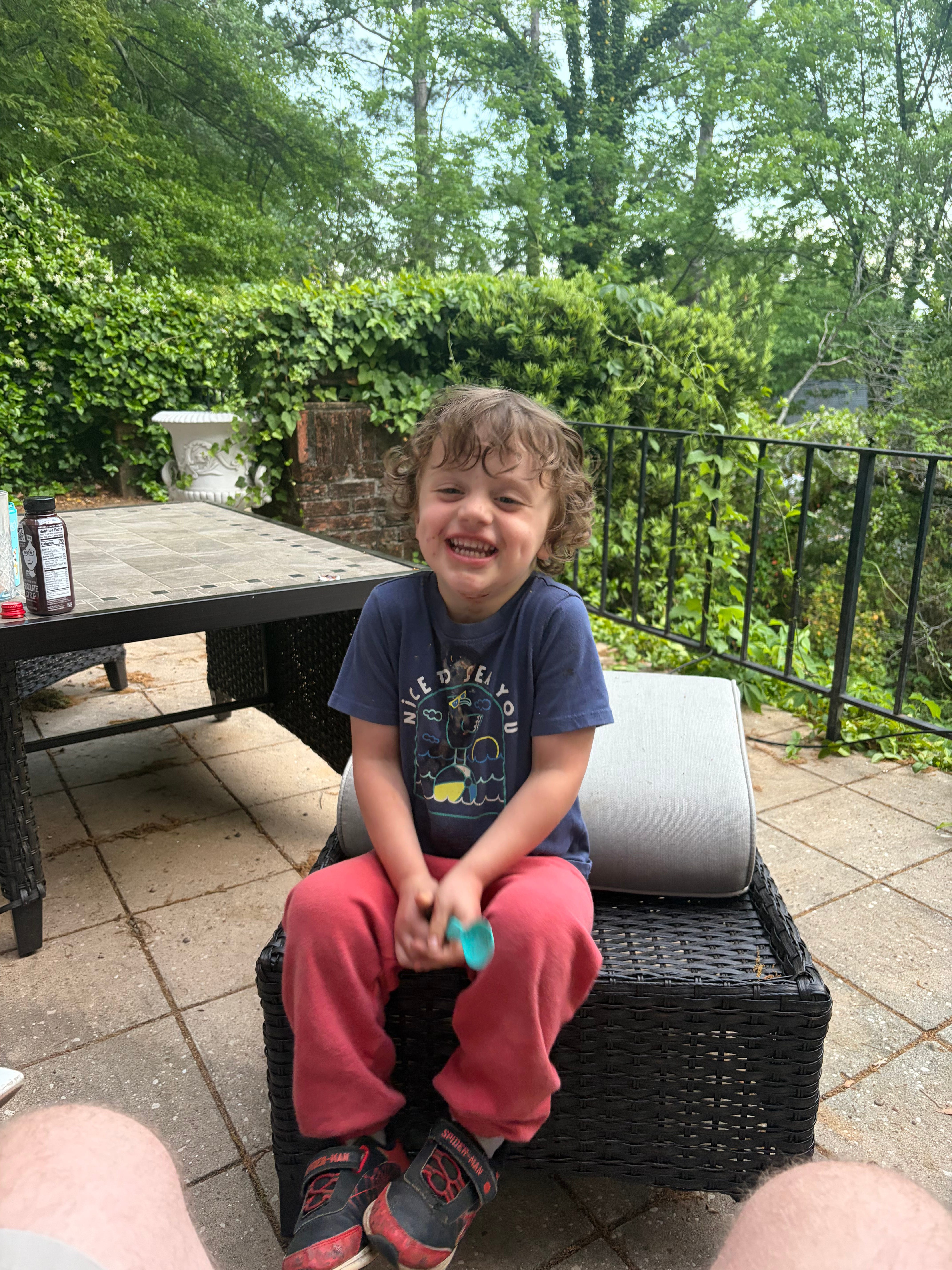
Tavi is so singularly and openly proud of veganism that it is the first thing he tells…everyone.
It is almost his last name: “I’m Tavi…I’m vegan.” That is actually how he introduces himself.
He is so proud because for him vegan is not a diet; it is a worldview of caring and belonging and safety — where no one hits and no one is hit, where no one yells and no one is yelled at, where vegans care about animals and since every human is an animal, every human is also cared for, including him. So of course he immediately tells everyone: “I’m Tavi…I’m vegan.”
He is not telling people what he doesn’t eat; he is telling people why he is so happy.
If we want to win, here is how we have to help others understand veganism: not as a diet, but as my son understands it, as I do, as my spouse does — as radical joy, as wholeness, as family, as something we get to embrace as a life philosophy that nurtures and enriches every single part of our lives.
Veganism is not a diet; it is the way we move through the entire world.
It defines us. It is the way we treat every single animal, including every human, because they too are always and already animals. What I hear over and over again is that the way to grow the movement, to get more people to join, is to water it down: if veganism is less, the thought goes, more people will want it.
I write this Substack to tell you the exact opposite:
What people are hungry for is not less, but more: more meaning, more purpose, more community, more wholeness, more integrity.
People already feel compartmentalized, divided from themselves and from others. We, as vegans, offer the exact opposite: the possibility of wholeness, of purpose, of meaning, of courageous truth, of living a life based on values. People do not fight for small things; they fight for big ones. They don’t fight for things that matter less; they fight harder for things that matter more. Making veganism smaller just makes it…smaller.
The question that always means the most to me is people’s vegan origin story — what made them first go vegan? It can, at times, be a hard story to get to hear honestly. But when I do, for everyone I have ever known who has fully committed, it is always based on some level of connection. An understanding that we are all fighting for ourselves as much as we fight for others, that the very division itself is meaningless. That all of us are together in the liberation club.
Intersectionality — the idea that veganism should include other social justice issues — isn’t an addition or a change; it is just…veganism.
Veganism means wholeness; it means integrity. Animal liberation includes every human, because humans are also animals and animal liberation is only possible if they, too, are liberated. As people who understand this not only go vegan, they stay vegan — and not only do they stay vegan, they fight fully for veganism — and not only do they fight fully for veganism, they can feel a special kind of joy: the joy of purpose; the joy of integrity. That is the joy you, too, have. It is the joy we get to share, together. It is the joy at the center of my biological family. It is the joy at the center of my chosen family. It is the reason that my son tells everyone, immediately, that he is vegan, with joy, with pride, as though it were his last name.
Because at four he has yet to learn that it could ever mean anything else.
Every Substack always ends the exact same way. But here is the simple truth: the winning itself always has two parts. The winning we are all working toward, and the winning that is already happening right now, today — just by getting to be vegan, the winning of getting to live all our values all of the time.
Living our veganism fully, with integrity, in both public and private, as though it was our last name— that is how we win.
And, today, just by being vegan, we have already won.
"Happiness" is the received translation for eudaimonia that most authors use. Technically, it is more like "flourishing." However, "flourishing" works even better for this argument than just "happiness."
In Book IX (chapters 4 and 8), Aristotle argues that the virtuous person experiences self-love (philautia) and is in harmony with themselves, while the vicious person flees (pheugein) their own company.
Beautifully expressed.
Thank you for your post, it has really moved me. Your definition of veganism sums it up beautifully and has pin pointed what it should be and what I believe it is all about but have struggled to voice to others. Your so right in saying, it's not about what we eat but a way of life, to treat everything , animal and us animal humans with respect and dignity.. I am so pleased to have come across your post, it has enlightened me to have more strength and insight into my beliefs, not to compartmentalized our private and public lives but to live with integrity. At times I have felt my empathy, in many areas of my life, as a weakness by some but I can now see it's part of veganism. I am by no means perfect but can try and embrace more happiness from who I am striving to be and how I can try and pass it on to others.
Many thanks and happiness.
Jo x